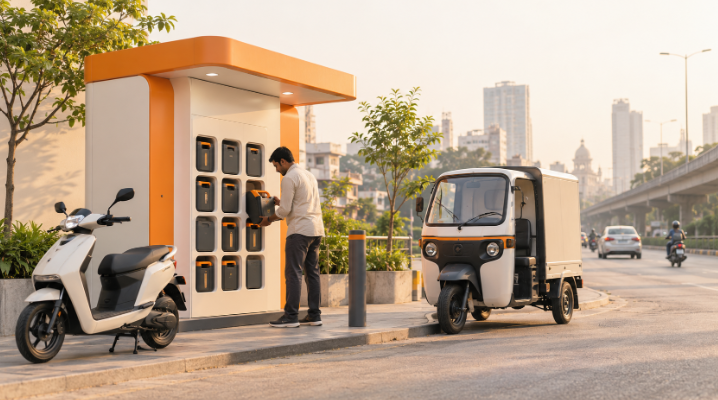
I spent nearly two decades working in telecom infrastructure before moving into EV infrastructure in 2021. While the technology was different, many of the operational challenges felt familiar.
A working battery, a reliable swapping station, and vehicles ready to use it are all necessary. But bringing a station into operation also means finding a suitable location, getting an electricity connection, financing the batteries, and working through the policies that apply to the site.
These are the parts of infrastructure development that receive less attention, although they can have a considerable influence on how quickly a network grows and how reliably it performs.
As battery swapping in India expands, I think these questions will become more important. Commercial vehicles that spend much of the day on the road give swapping a clear use case. Their drivers need charged batteries available in the right places, with as little disruption to the working day as possible.
From my experience of deploying and operating this infrastructure across Indian cities, four challenges deserve particular attention.
1. Finding the Right Land Takes More Than Finding Enough Space
Battery swapping has an advantage in crowded cities because the vehicle does not need to remain parked while its battery charges. A driver arrives, exchanges the battery, and returns to the road. This makes the model useful in locations where land is expensive and vehicles need to remain productive through the day.
But a small station still needs a suitable site, and finding one involves more than checking how much space is available.
The location needs to be close to where vehicles operate. Ownership and documentation need to be clear, rental terms need to work, and the site must be able to support the electrical infrastructure behind the station. A location that looks suitable during an initial visit may become less practical once these details are examined.
When we built our field operations structure, site acquisition and estate management became a dedicated function alongside deployment and O&M. As the network expanded, we needed people who could manage the work involved in securing sites and maintaining those relationships over time.
Signing an agreement is only the beginning. Rentals, documentation, coordination with owners, and the continued commercial viability of the location all need attention once the station is operating.
The government has started recognising this challenge too. India’s battery swapping guidelines recommend making public land available for battery swapping infrastructure through revenue-sharing or competitive bidding models.
That can widen the options available to operators. The practical question, however, is whether those locations are where customers need them. A network becomes useful when its stations fit into the routes and working patterns of the vehicles it serves.
2. Getting Power to the Site Requires Its Own Deployment Effort
Once a site has been identified, electrification becomes one of the most important parts of bringing it into operation.
The swapping equipment may be the same across locations, but the work required to supply it with power can vary considerably. One site may already have adequate capacity. Another may need additional electrical work or a dedicated transformer. Documentation, approval processes, and the electricity authority involved can also differ from one geography to another.
At an earlier stage of our network, our electricity board energisation turnaround time was around 85 days. As the team understood the processes better and built stronger deployment systems, we brought that down to around 28 days.
What that experience taught me was the importance of managing electricity connections as a deployment activity in their own right. The improvement came from understanding the work, coordinating it more consistently, and building that knowledge into the team’s processes. It did not mean that every location would have the same requirements or could be completed within the same period.
When entering a new geography, the team needs to understand which authority handles the approval, what documentation is required, whether the necessary load is available, and what additional infrastructure may have to be installed. These questions need to be addressed early because they affect both the schedule and the cost of opening the station.
In my experience, close to 70% of the effort and cost involved in bringing a new station online can sit outside the swapping equipment itself, much of it around the electricity connection and electrification behind the site.
Policy support is beginning to address this part of the problem. Under PM E-DRIVE, ₹2,000 crore has been allocated to public EV charging infrastructure. Battery Swapping Stations and Battery Charging Stations are also eligible for 80% support for upstream infrastructure.
For operators, support for that work is valuable because equipment installation is only one part of making a site operational. The land and swapping equipment may be ready, but customers can only begin using the station once adequate power is available.